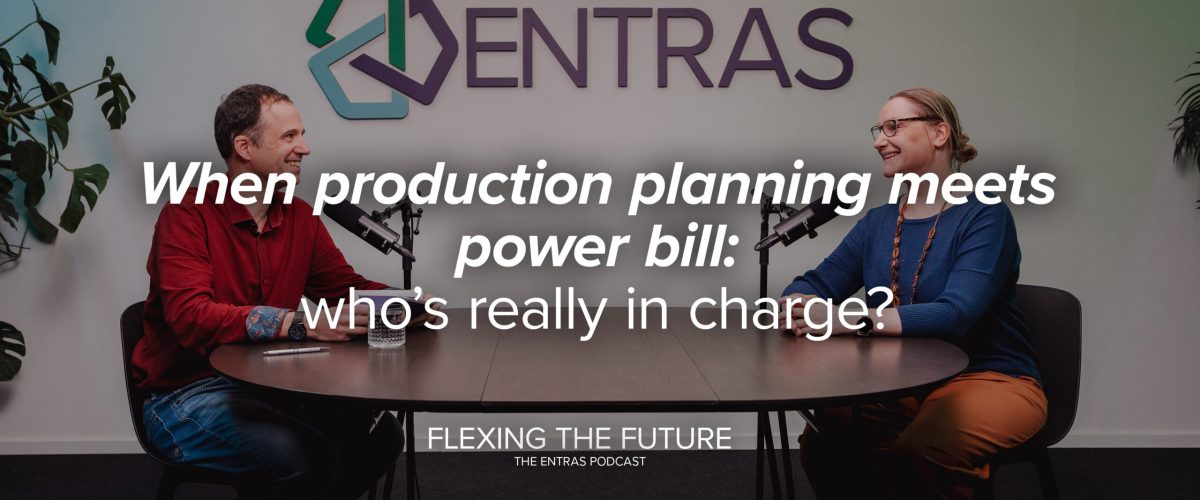
In this episode of Flexing the Future, Frank Alaerts talks to Miek Weverbergh, founder and managing partner of Allics, about the connection between production planning and energy cost control. While supply chain management has traditionally focused on balancing customer service, inventory and operational costs, energy was often treated as a fixed and readily available resource. Today, volatile prices, electrification and the growing share of renewable energy are turning energy into an increasingly important planning variable.
A central challenge is that supply chain, operations and energy management are often organized in separate parts of the company. Planners may understand demand, capacity and inventory, but rarely have access to energy price forecasts or a clear view of how production decisions affect energy costs. Energy specialists, meanwhile, see the opportunities created by price volatility but may lack insight into the practical constraints of production planning. As a result, companies often recognize the problem without translating it into coordinated action.
The discussion explores how energy can be incorporated at different planning levels. Companies could start by adapting production volumes on a monthly or weekly basis, producing more during periods with lower expected energy prices and less during expensive periods. More advanced optimization may involve hourly price fluctuations, but this requires tighter process control and greater operational flexibility. Other opportunities can be captured without immediately changing the production schedule, for example by switching between gas and electric boilers or using hot-water storage as a virtual battery.
Not every company will benefit equally. The opportunity depends on the importance of energy within the total cost structure, the availability of excess production capacity and the possibility of shifting volumes through inventory or lead times. The first step, however, is simple: bring supply chain and energy specialists together. By understanding each other’s challenges, cost drivers and degrees of freedom, companies can determine whether they can use volatile energy prices to their advantage rather than simply suffering from them.
Discover the full conversation in this new episode of our podcast Flexing the Future.